Designed the content and screens for a flow that lets newcomers to Canada bring their credit history from home, so a new start doesn't mean starting from zero.
Credit bureau for newcomers
Designed the content and screens for a flow that lets newcomers to Canada bring their credit history from home, so a new start doesn't mean starting from zero.
Role
Sole designer: content, interaction & visual
company
RBC Royal Bank of Canada
year
2024 (consent explainer launched)
team
Credit cards and New to Canada product directors
overview
A credit history that doesn't cross the border
When people move to Canada, the financial standing they built at home doesn't come with them. With no Canadian credit file, newcomers start from zero: low limits, fewer approvals and a harder time with everyday things like a phone plan.
RBC planned a tool that let newcomers retrieve their credit report from their home country and share it with the bank. The first benefit would be a higher credit limit on their first RBC credit card, and the start of a longer relationship as they build a life here.
I was the only designer, responsible for the content, interaction and visual design across desktop and the mobile app. I'm showing it here as a content design project, because the hardest part was explaining an unfamiliar idea to people who were often reading in their second or third language.
the problem
No Canadian credit file means starting from scratch
Settling in Canada is closely tied to credit. A credit report is needed for anything from a phone plan or a credit card to a mortgage, and newcomers don't have one yet.
Other banks were already offering newcomers higher limits from the start. Without a way to see a client's credit history from home, RBC saw too much risk to do the same.
how might we
How might we give newcomers access not only to credit, but to a credit limit that actually supports day-to-day life in Canada?
what we knew
Two years of newcomer research shaped the words
The team had spent more than two years studying the newcomer space, with advisors who support newcomers and with newcomers themselves. These findings decided what the content had to explain, and what it couldn't assume.
Top countries
India, the Philippines and China (including Hong Kong) are the top three countries newcomers come from, followed by Nigeria.
Credit reports are unfamiliar
Many newcomers don't know what a credit report is or how it affects day-to-day life.
Home credit goes unnoticed
Many newcomers don't realize they already have a credit profile in their home country.
A five-year goal
Most newcomers said their goal is to own a home in Canada within five years. That makes building credit early essential, not optional.
Credit cards come first
Advisors told us newcomers come to the bank asking for a credit card.
So the content had to
Explain what a credit report is, tell people they probably already have one, and connect it to what they want: a card now and a home later.
constraints
Every constraint became a content problem
The technology came from a third-party provider, and what it could do changed from country to country. Each limit was something the screens had to say clearly, without making the flow feel broken.
Three countries at launch
The MVP covered only India, China and the Philippines, with more to follow. Everyone else needed an honest answer, not a dead end.
China, but not Hong Kong
The provider could reach mainland China only. How do we say that so people from Hong Kong don't choose China and fail later?
Different steps by country
Some countries needed a home-country phone number, some needed both addresses, and some needed people to download their own report and upload it.
content approach
Four rules for the content
The flow asked people for personal details, a phone number they might no longer have and consent to share a financial record across borders. The content had to earn that trust one screen at a time.
01
Explain before you ask
Say what a credit report is and why it matters before asking anyone to share one.
02
Show the whole path
List every step up front, each in one plain sentence, so nothing comes as a surprise.
03
One flow for every country
Write screens that work whatever the country, so the flow can grow without new copy each time.
04
No dead ends
If we can't help yet, say so honestly and answer the next question people will have.
words we chose
Three terms I went back and forth on
The flow introduced an unfamiliar idea to people who were new to the system. Every key term had to be clear, credible and consistent from the first screen to the last.
credit history or credit report
We chose: credit report
“History” describes what's actually happening, but “report” lines up with how credit is scored. It's also more explicit about what's being shared, and it sounds more credible.
Credit history is an unfamiliar idea for many newcomers, so “report” was the more universal word. I updated every instance across the flow, including the consent and terms screens.
home country or country of origin
We chose: home country
We debated both. “Country of origin” was misleading: it points to where someone is from, not where they built their credit. “Home country” asks the question we actually needed answered.
newcomer
We kept: newcomer
The team worried “newcomer” had negative connotations. I showed the concern didn't hold up: the Government of Canada uses “newcomers” in its official spaces, and the word also covers people who start the process before they arrive in Canada.
task flow
Two countries, two paths, one ending
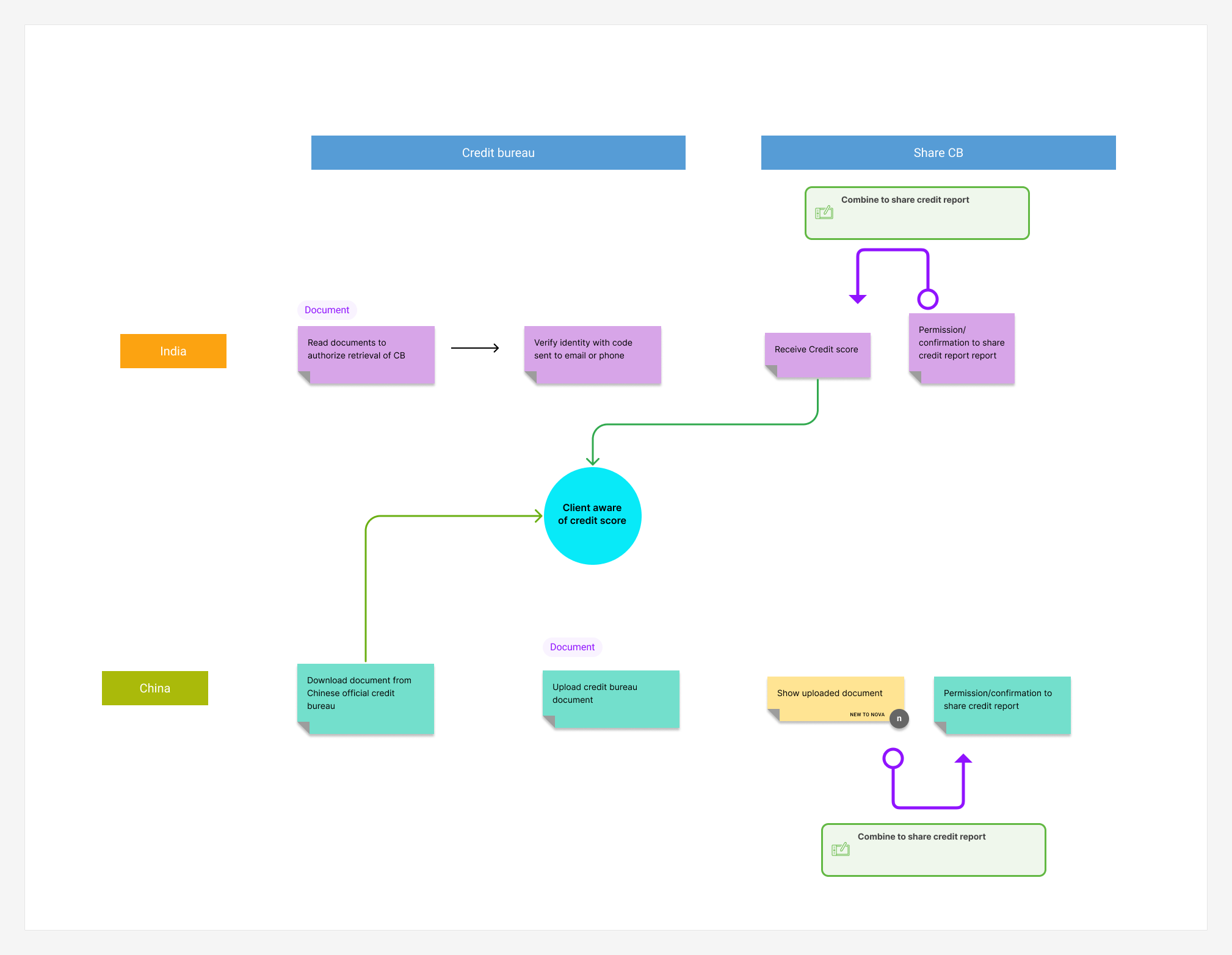
I mapped the task flow first. In India, people verify their identity with a code, read the bureau's documents and give permission to retrieve their report. In China, they download the report from the official bureau and upload it themselves.
Both paths end in the same place: permission to share the report with RBC. Seeing that early is what made one shared screen, and one set of words, possible.
Task flow: the India (retrieve) and China (upload) paths combine to share the report
Annotated flow, noting what each country requires at each step
exploration
Sketches and greyscale user flow
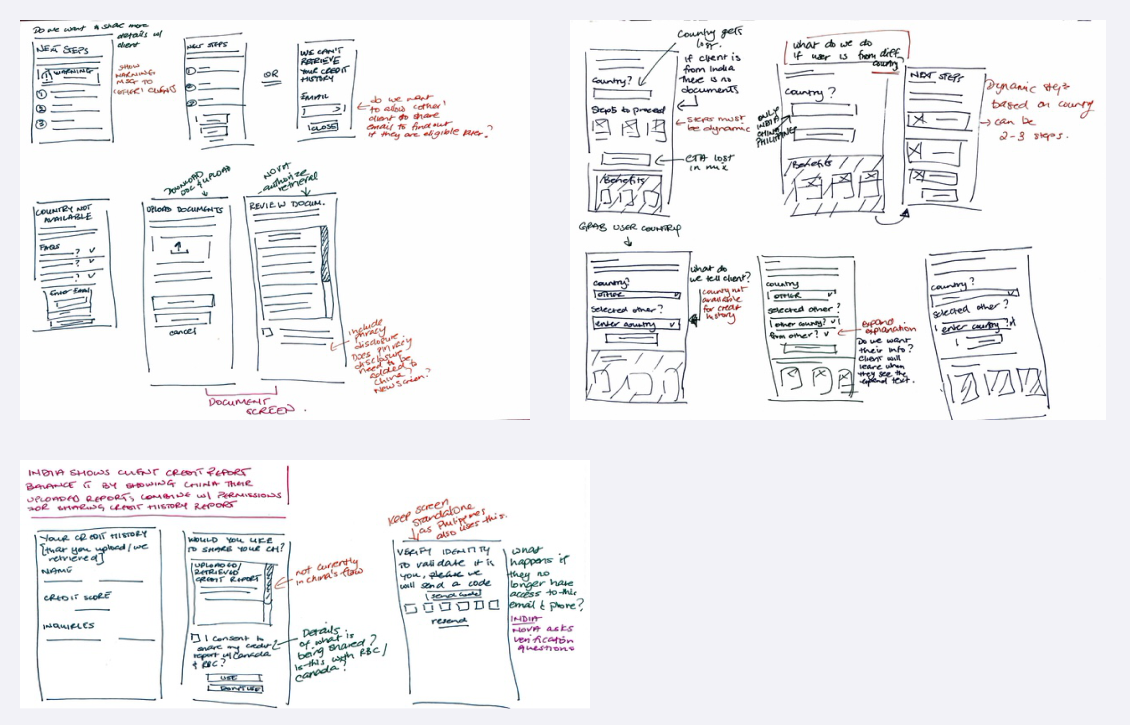
I started on paper, sketching each step and writing the open questions beside it: what if someone is from a country we can't reach yet, what if they no longer have their home phone number, and could the steps change by country? Those notes became the list of things the content had to answer.
Early sketches, with open questions noted in red
From sketches to a greyscale flow
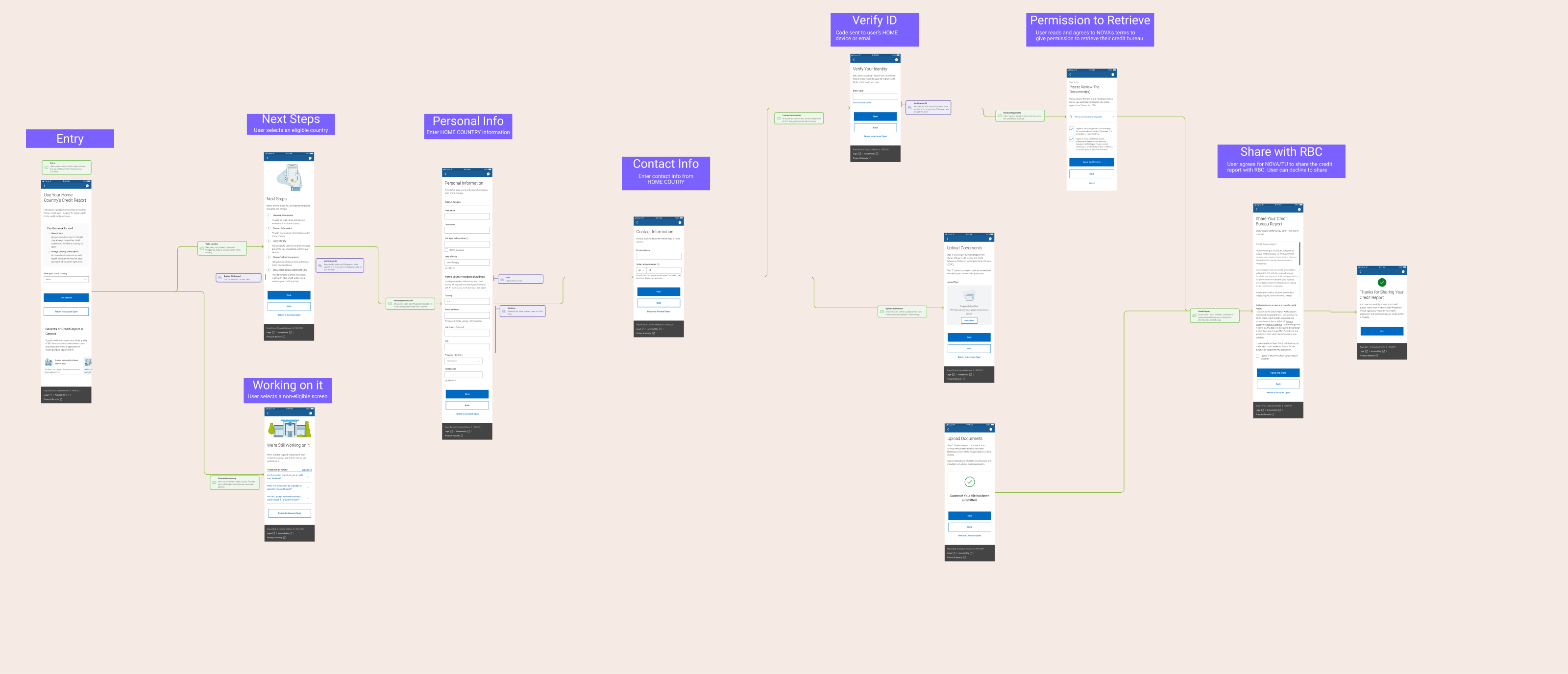
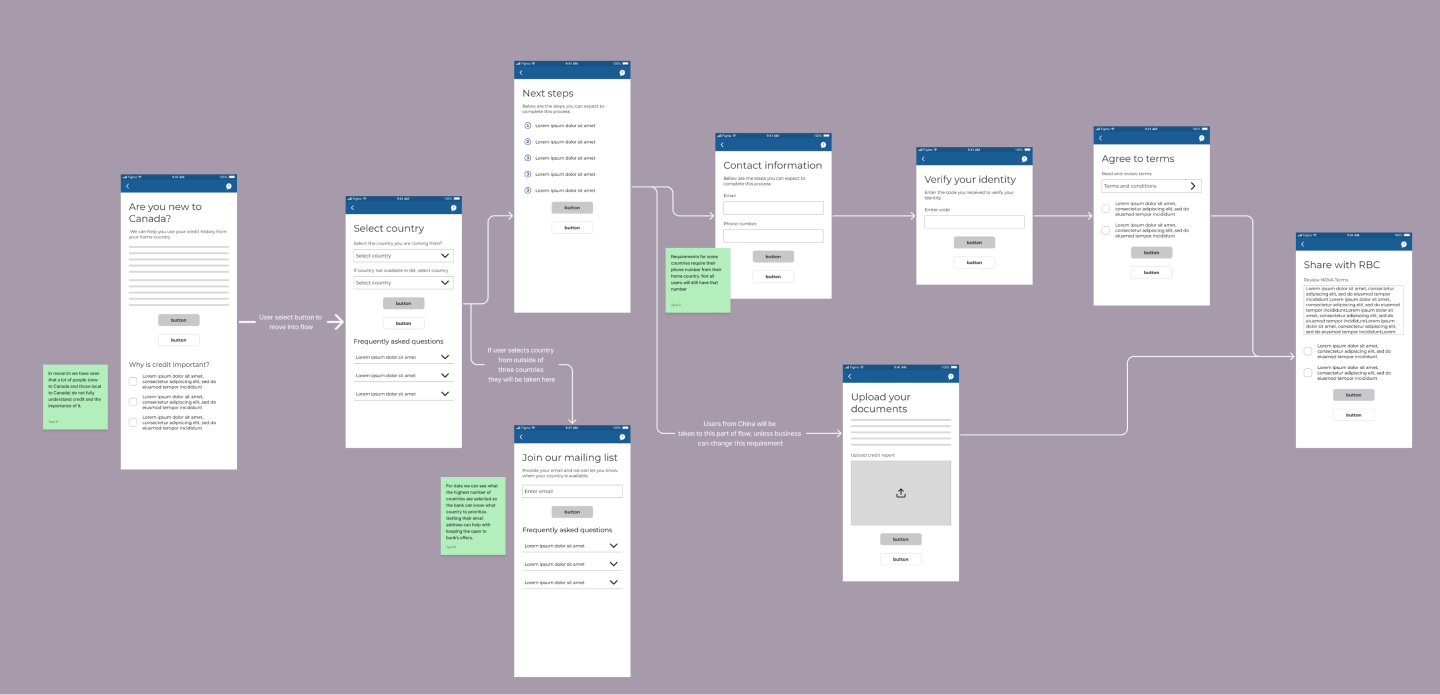
The greyscale flow tested the structure before any visual design: an opening that asked “Are you new to Canada?” and explained why credit matters, a country picker with frequently asked questions, then contact details, verification, terms, an upload branch and sharing with RBC.
Mapping it end to end showed where countries would split and where one screen could serve everyone. It also showed what to change. The early version sent unsupported countries to a mailing list sign-up, and the final design replaced it with an honest status and questions that point to next options.
Greyscale user flow, including the upload branch and the path for countries not yet supported
the flow
Screen by screen: getting started
Newcomers could reach the flow from several places: the assisted account opening process on desktop, and a web view in the mobile app when they received a credit card offer within 60 days of opening a chequing or savings account.
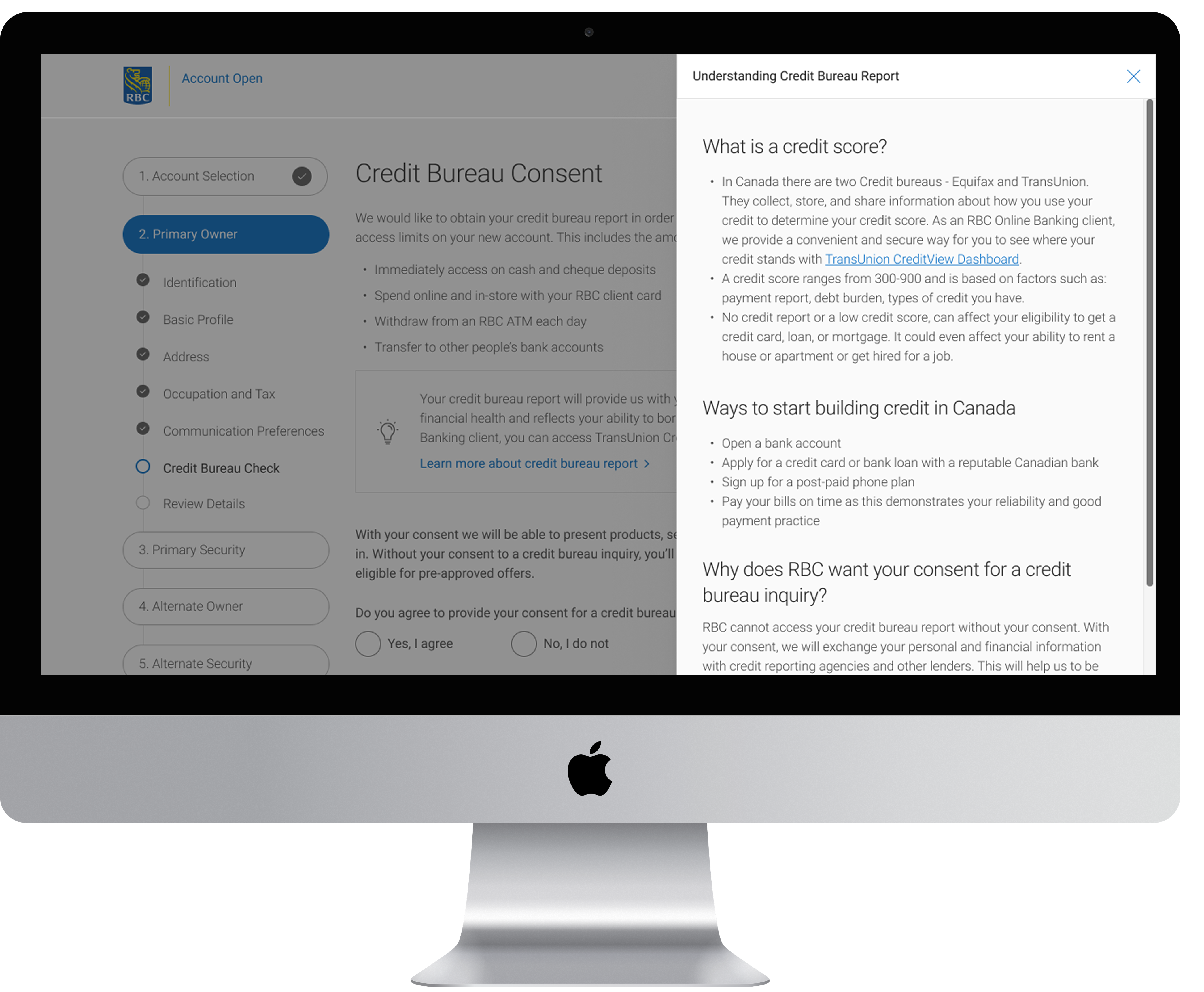
Credit bureau consent, with the explainer open
account opening
Teach the term before using it
Everyone opening a chequing or savings account is asked to consent to a Canadian credit check. I added an explainer behind “Learn more about credit bureau report”: what a credit score is, the two Canadian bureaus, ways to start building credit in Canada and why RBC asks for consent at all.
For newcomers, that Canadian report comes back empty. The empty result is what made the home-country option worth offering next.
“RBC cannot access your credit bureau report without your consent. … It will also kick off your credit history in Canada.”
launched and tested
25
people tested the consent screen: 10 Canadians and 15 newcomers. All of them said they really liked the information.
77%
of people who agreed to share their credit report opened the side drawer explaining credit in Canada.
1.5 min
was the average time people spent reading the drawer before closing it.
“This is the first time I feel like I fully understand how credit history works in Canada.”
Canadian participant, 32
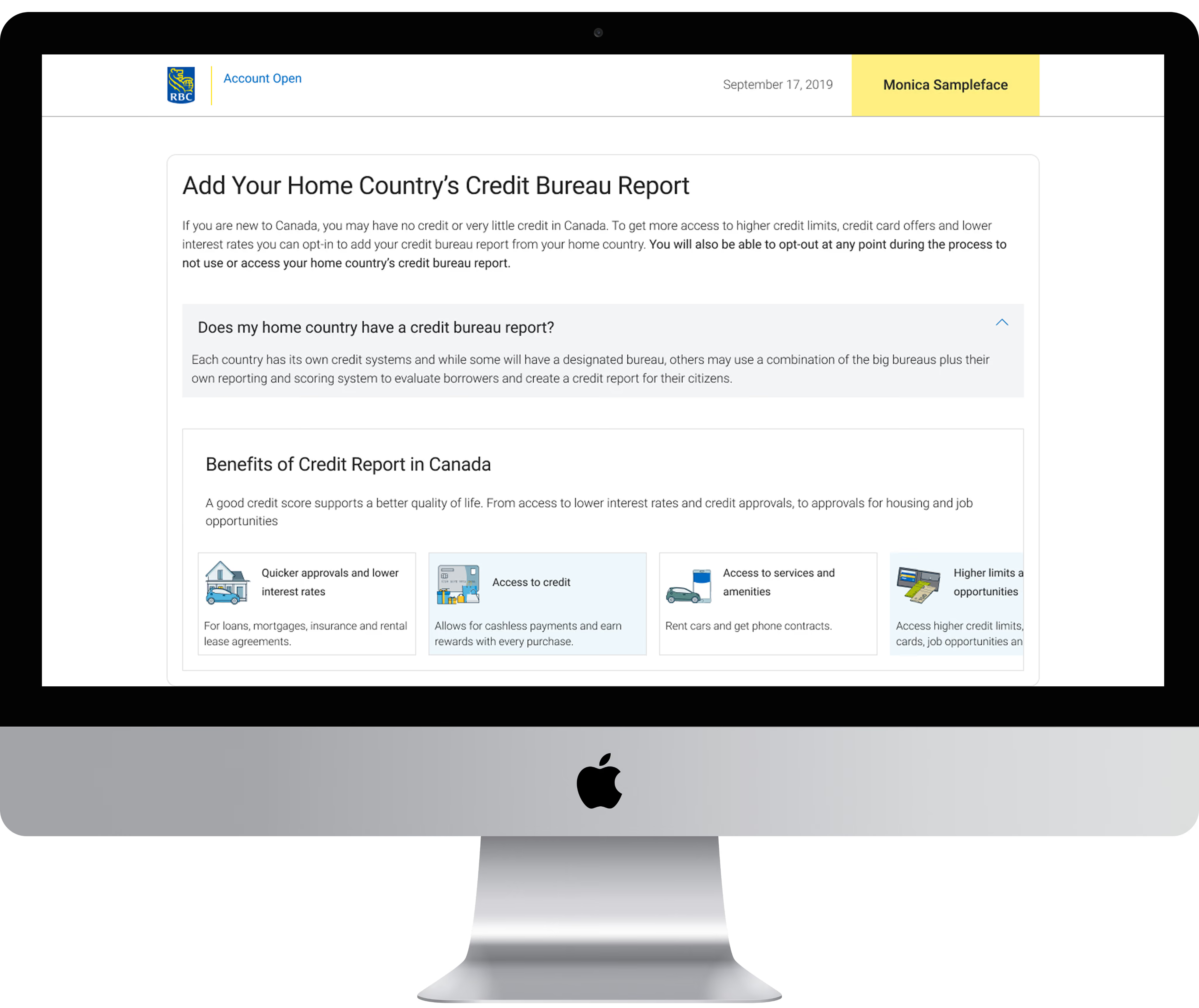
Add your home country’s credit bureau
the opt-in
Make it a choice, with an easy way out
Sharing a financial record from another country is a big ask. The opt-in screen says plainly who it's for and what they get, then makes two promises: people can opt out at any point, and they can return to account opening whenever they like. “Skip and Continue with Account Open” sits right beside “Next”.
“If you are new to Canada, you may have no credit or very little credit in Canada. … You will also be able to opt-out at any point during the process.”
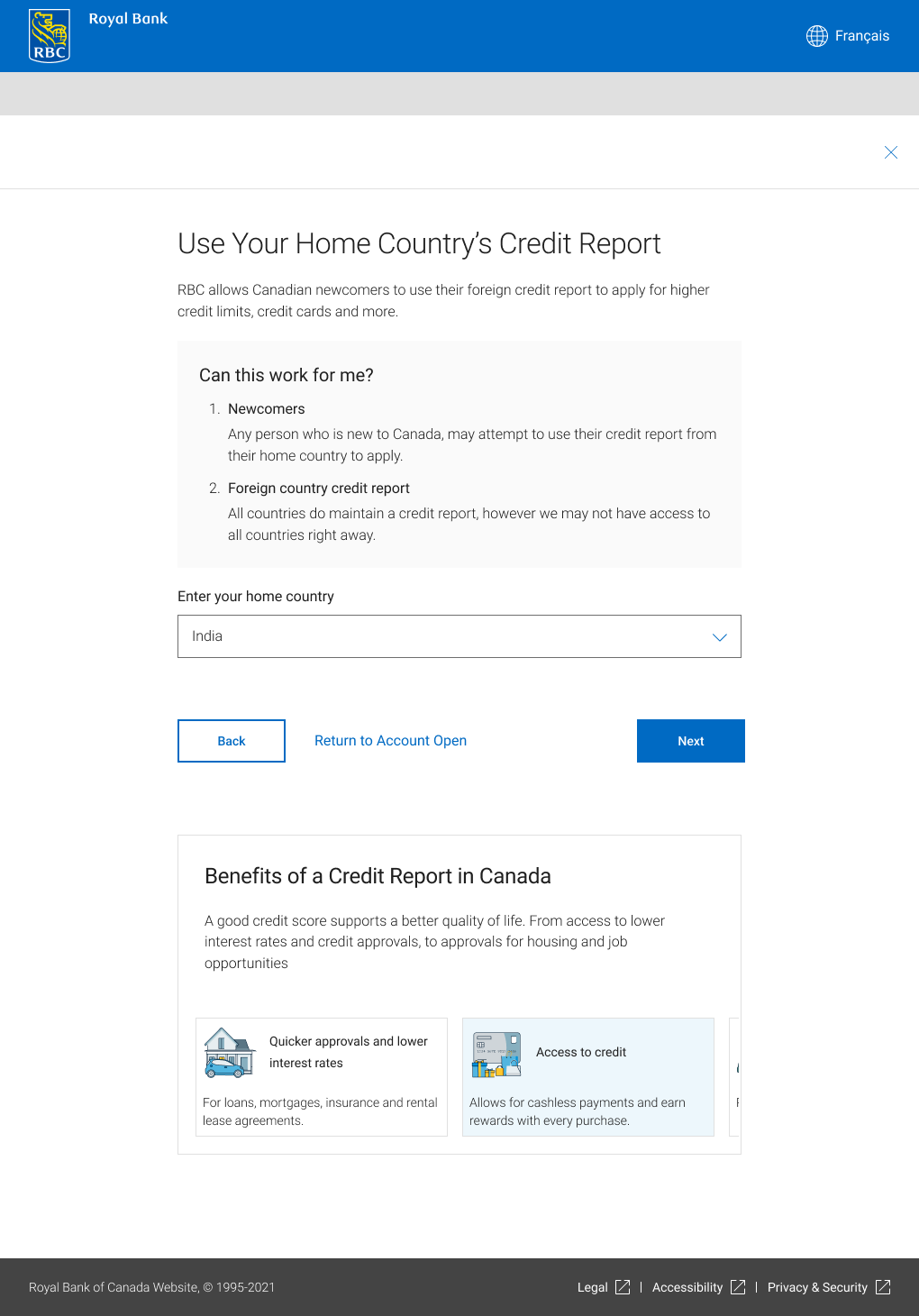
Entry screen
entry
Answer “Can this work for me?” first
Research said many newcomers didn't know they had a credit profile at home. So the entry screen opens with the question they'd be asking and answers it in two short points. Four benefit cards then tie a Canadian credit history to everyday life: approvals and interest rates, renting a car or getting a phone contract, higher limits, and cashless payments with rewards.
The country list includes every country, even though only three worked at launch. That showed the team where demand was, so we'd know which countries to add next.
“RBC allows Canadian newcomers to use their foreign credit report to apply for higher credit limits, credit cards and more.”
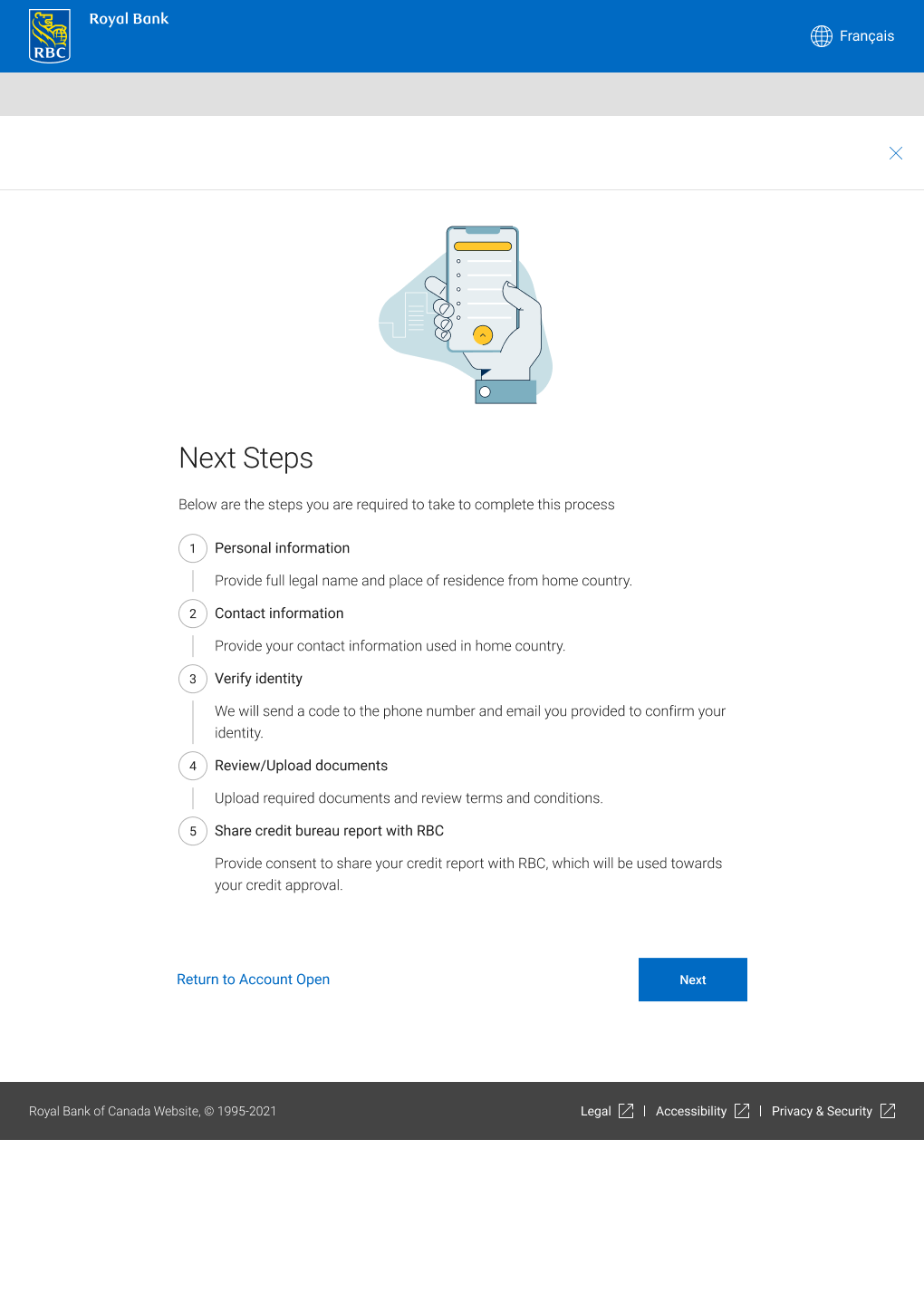
Next steps
before the form
Show the whole path
Before asking for anything, a numbered list sets out all five steps, each in one plain sentence. People know what they'll be asked for, including a code sent to their phone and email, before they start.
“Provide consent to share your credit report with RBC, which will be used towards your credit approval.”
the flow
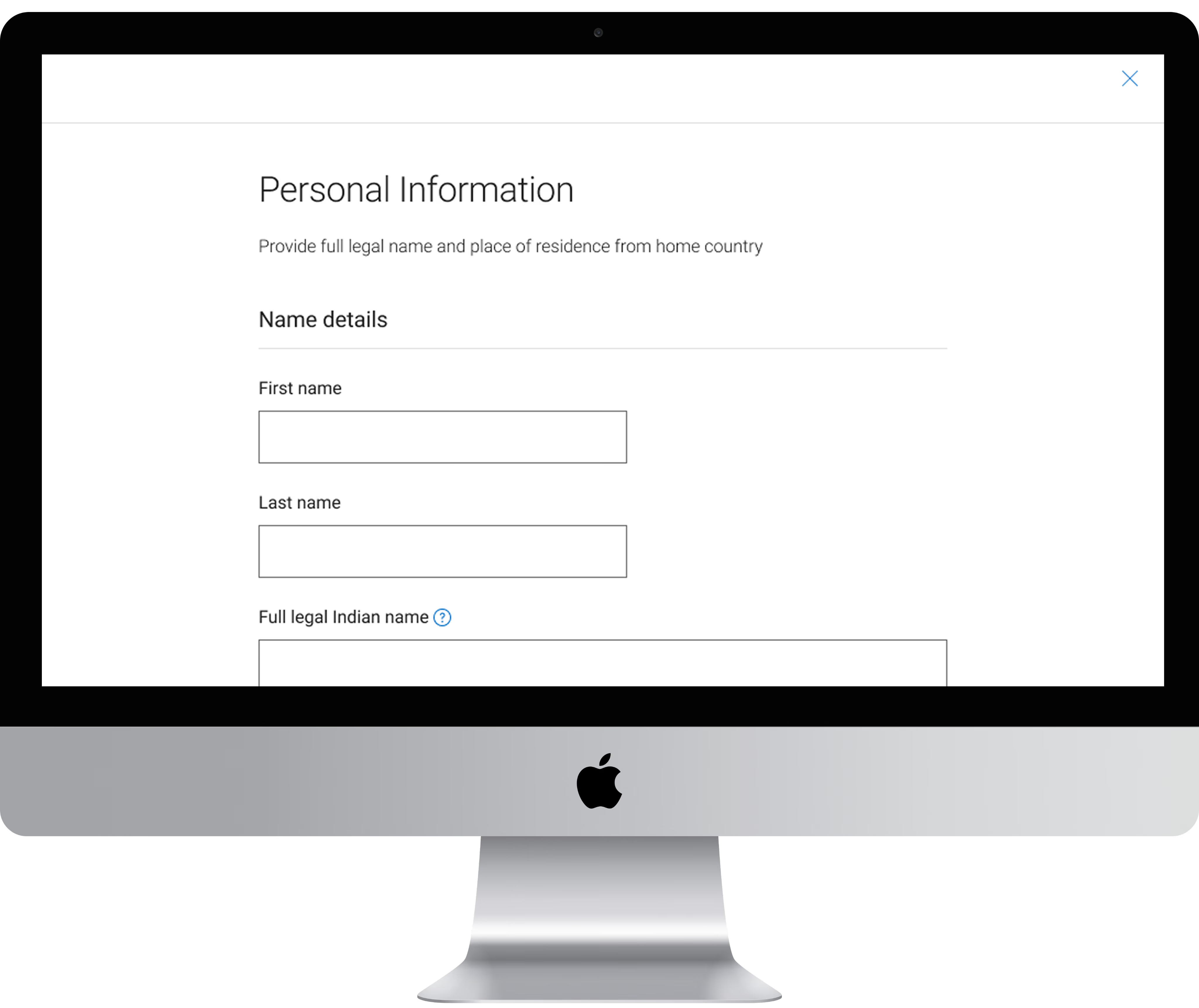
Asking for personal details
The provider needed some or all of these details depending on the country. Rather than a different form for each country, the team agreed on one standard set of screens for everyone, so the content had to explain why each detail was needed.
Personal information
step 1
Say why we need it, right where we ask
A home-country address on a Canadian banking form is unexpected, so the reason sits directly under the heading. The name field asks for the full legal name used at home, with a “Same as above” shortcut for people whose name didn't change.
“We require this to match your information with the credit bureau to retrieve your credit report.”
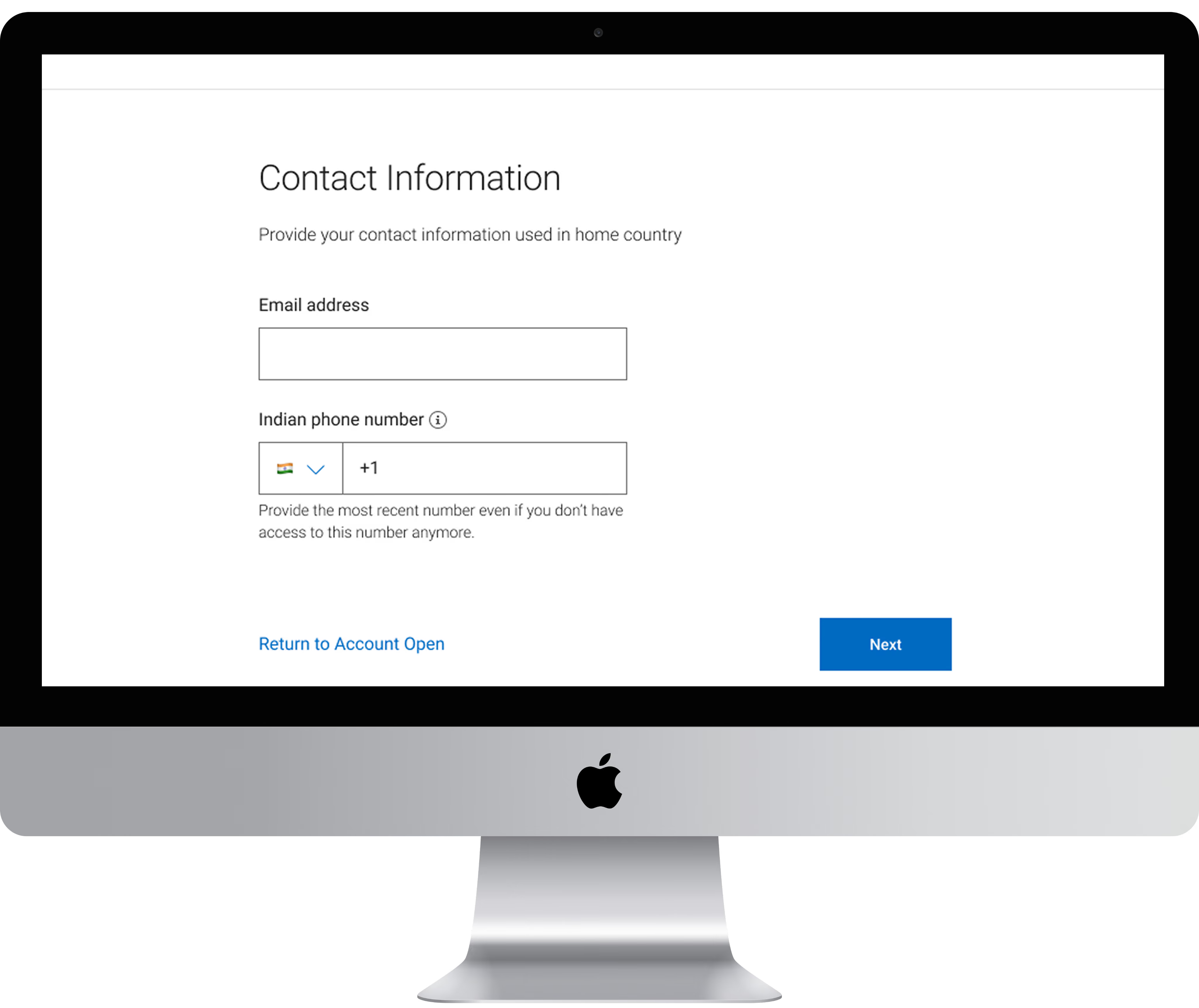
Contact information
step 2
Plan for the number they no longer have
Many newcomers no longer use their home-country phone number. The helper text tells them what to enter anyway, so they don't stall or abandon the form. Behind the scenes, the team was working with the provider to drop the phone number requirement altogether.
“Provide the most recent number even if you don't have access to this number anymore.”
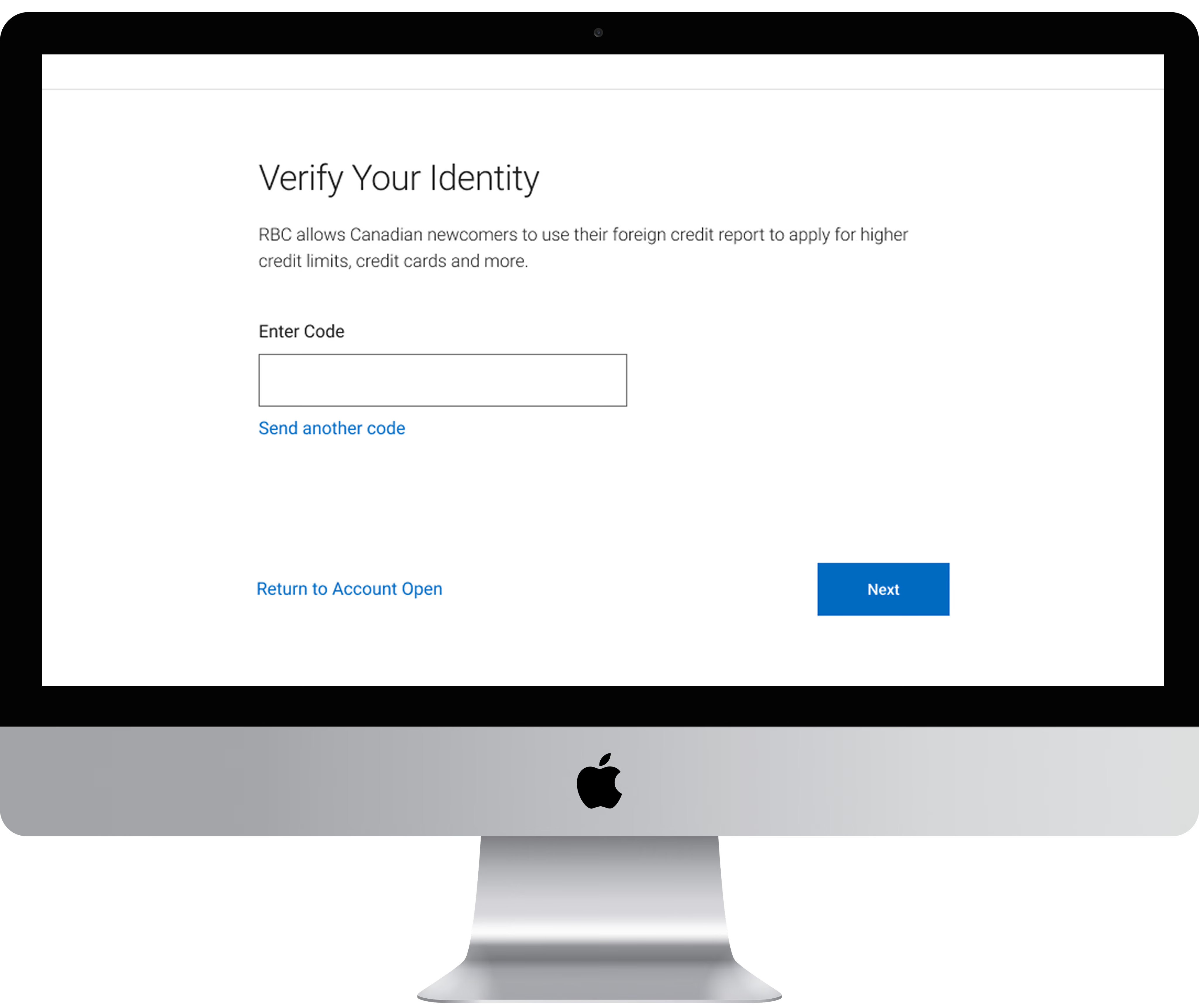
Verify your identity
step 3
Keep verification simple
Some countries verify identity with a code sent to a home-country phone or email. The screen asks for one thing, with “Send another code” close by. The team was pushing for email-only verification, for the same reason as the phone number.
the flow
Consent and sharing
Countries split into two paths here. In some, the provider retrieves the report for the person once they accept its terms. In others, such as China, people download the report themselves and upload it. Both paths end on the same screen.
Legal was aligned with the flow and with where consent was needed, but the project paused before final legal copy was provided. The consent and terms wording shown here is the working draft.
Review documents
step 4, path a
Name who's involved
The terms belong to the provider, not RBC, so the intro names the bureau the report comes from. The two agreements are separate checkboxes, so people consent to the privacy policy and to the retrieval one at a time.
“Please review the Terms and Conditions below before you authorize retrieval of your credit report from TransUnion CIBIL.”
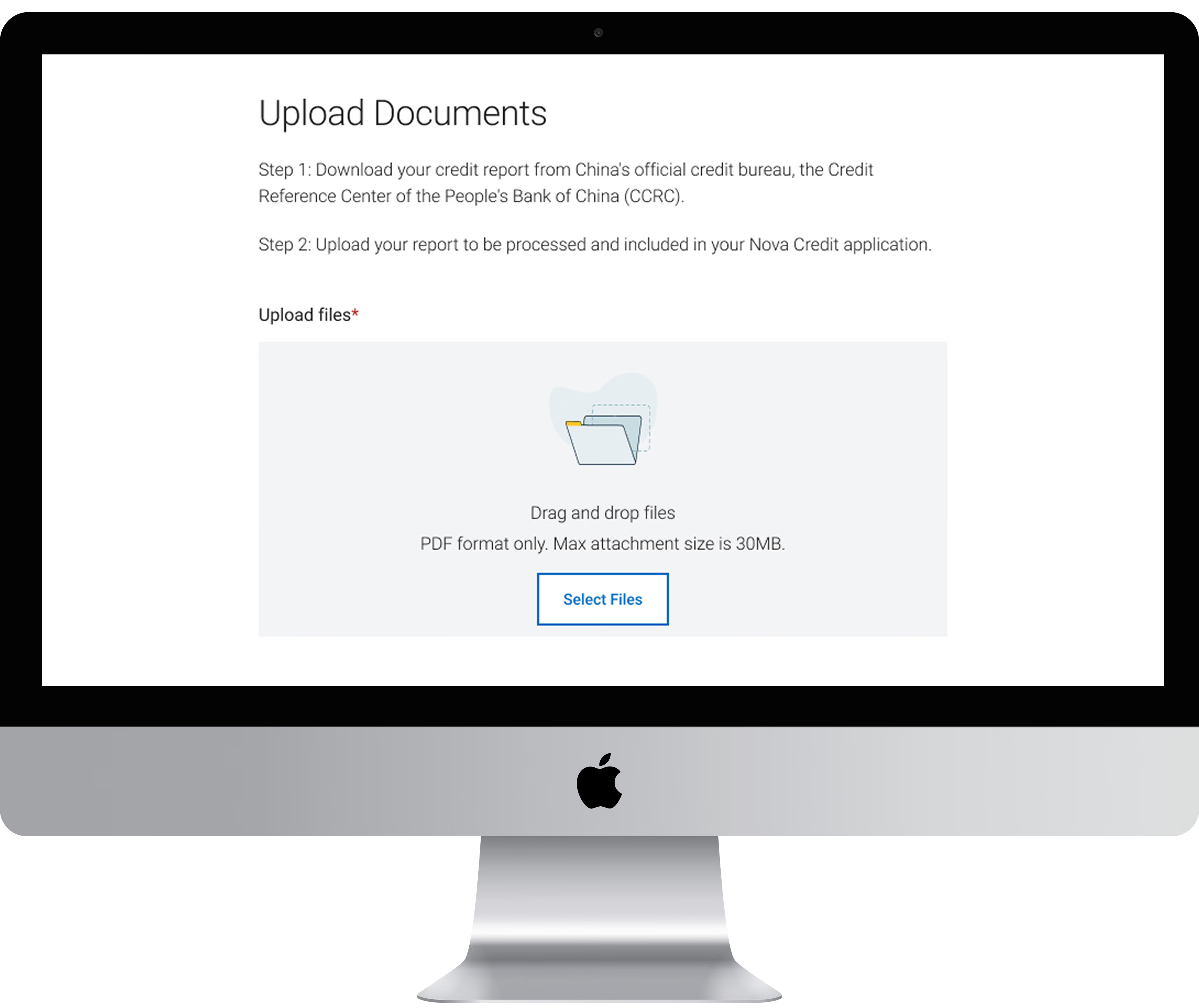
Upload documents
step 4, path b
Two numbered steps, and the official name
Uploading your own credit report is unfamiliar. The screen breaks it into two numbered steps and gives the bureau's full official name, so people can find the right report. File rules (PDF only, up to 30MB) sit inside the upload area, where people look when they need them.
“Step 1: Download your credit report from China's official credit bureau, the Credit Reference Center of the People's Bank of China (CCRC).”
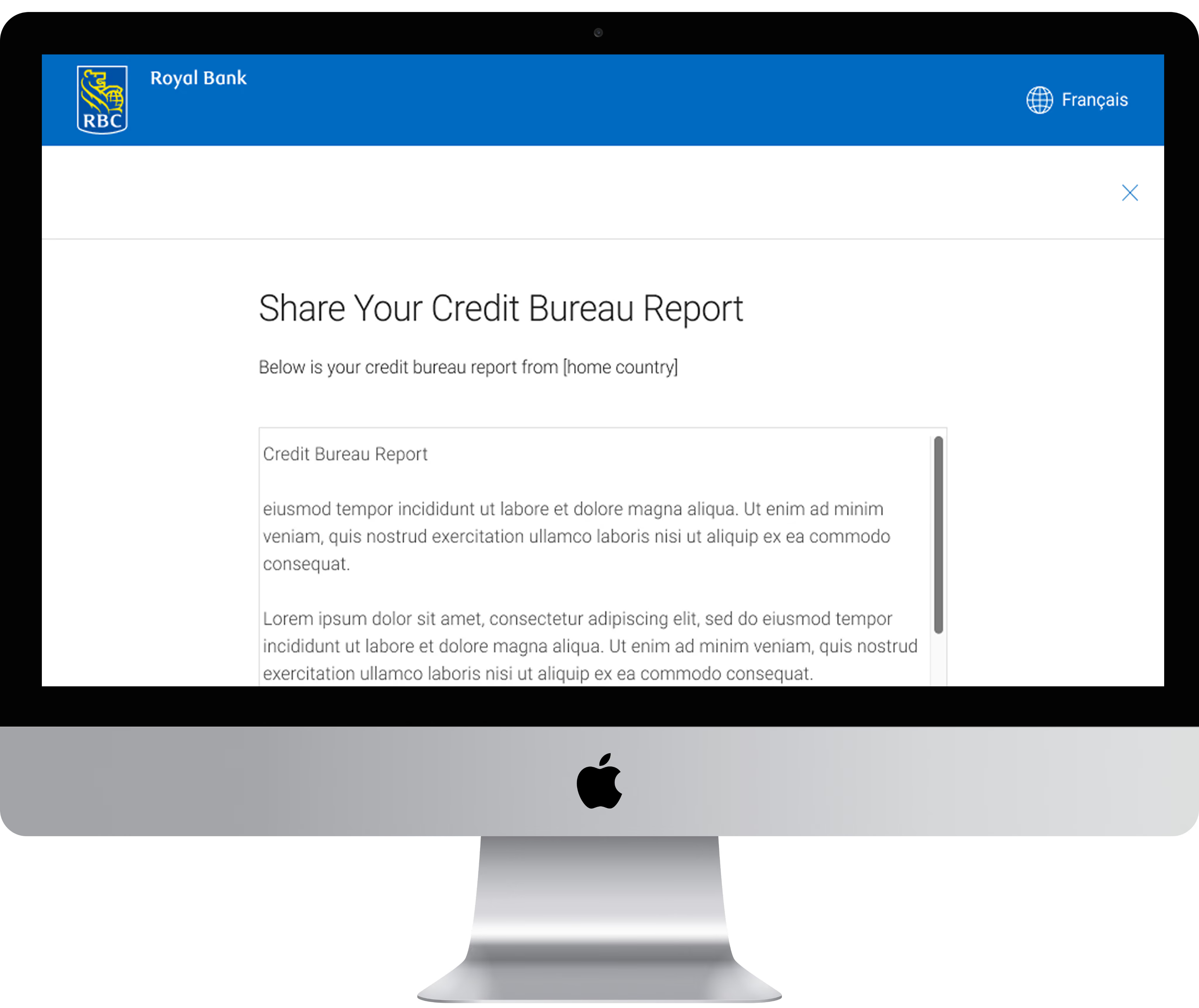
Share your credit bureau report
step 5
Let people see it before they share it
One screen serves both paths, which keeps the flow scalable. People read their own report first, then the authorization explains what sharing means, including that Canadian privacy laws may differ from those at home. Sharing is a final, separate checkbox.
“I agree to share my credit bureau report with RBC”
Report shared
done
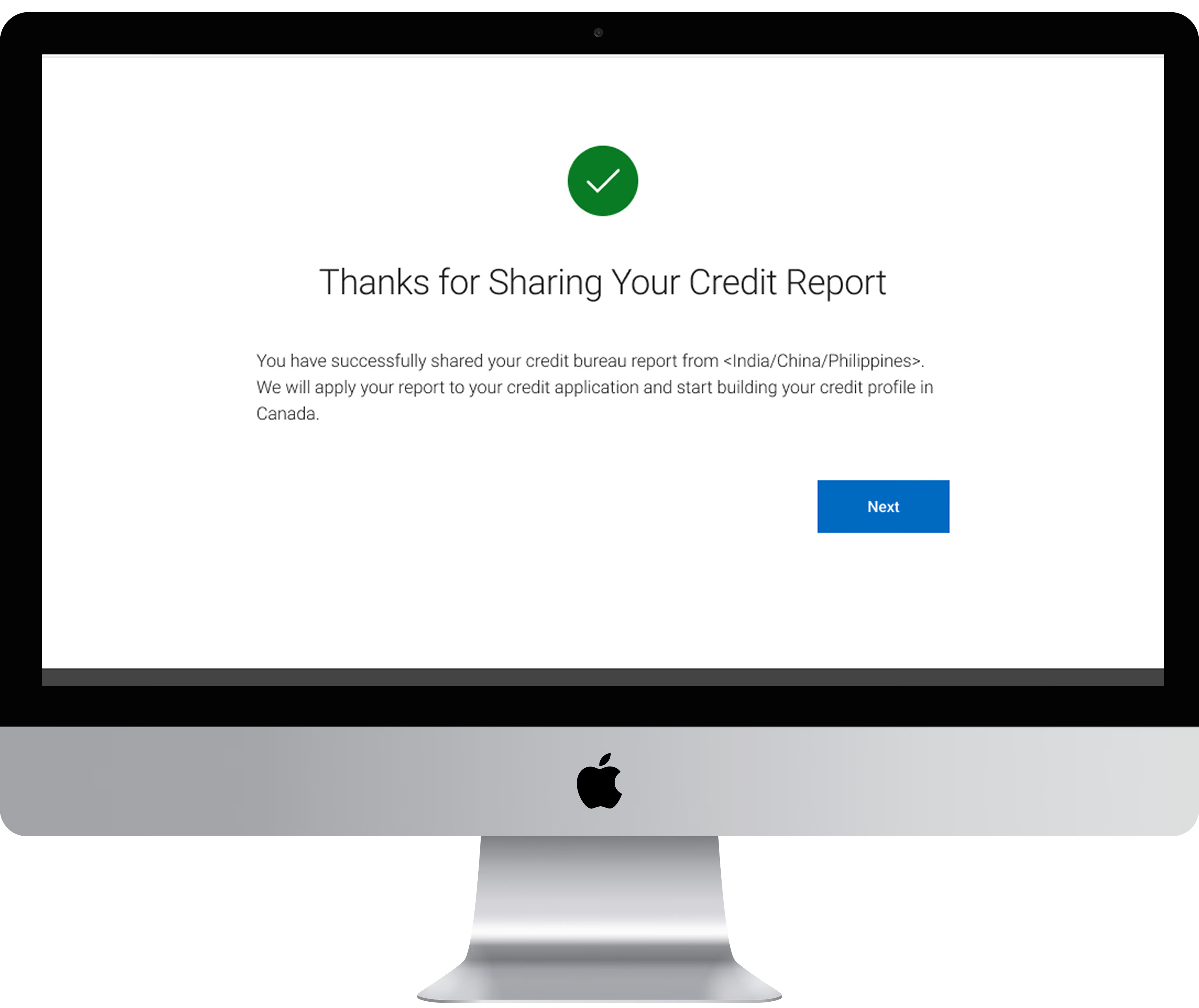
Confirm what happens next
The confirmation names the country, says where the report goes and links it back to the bigger goal: a credit profile in Canada.
“We will apply your report to your credit application and start building your credit profile in Canada.”
edge case
Country not available yet
no dead ends
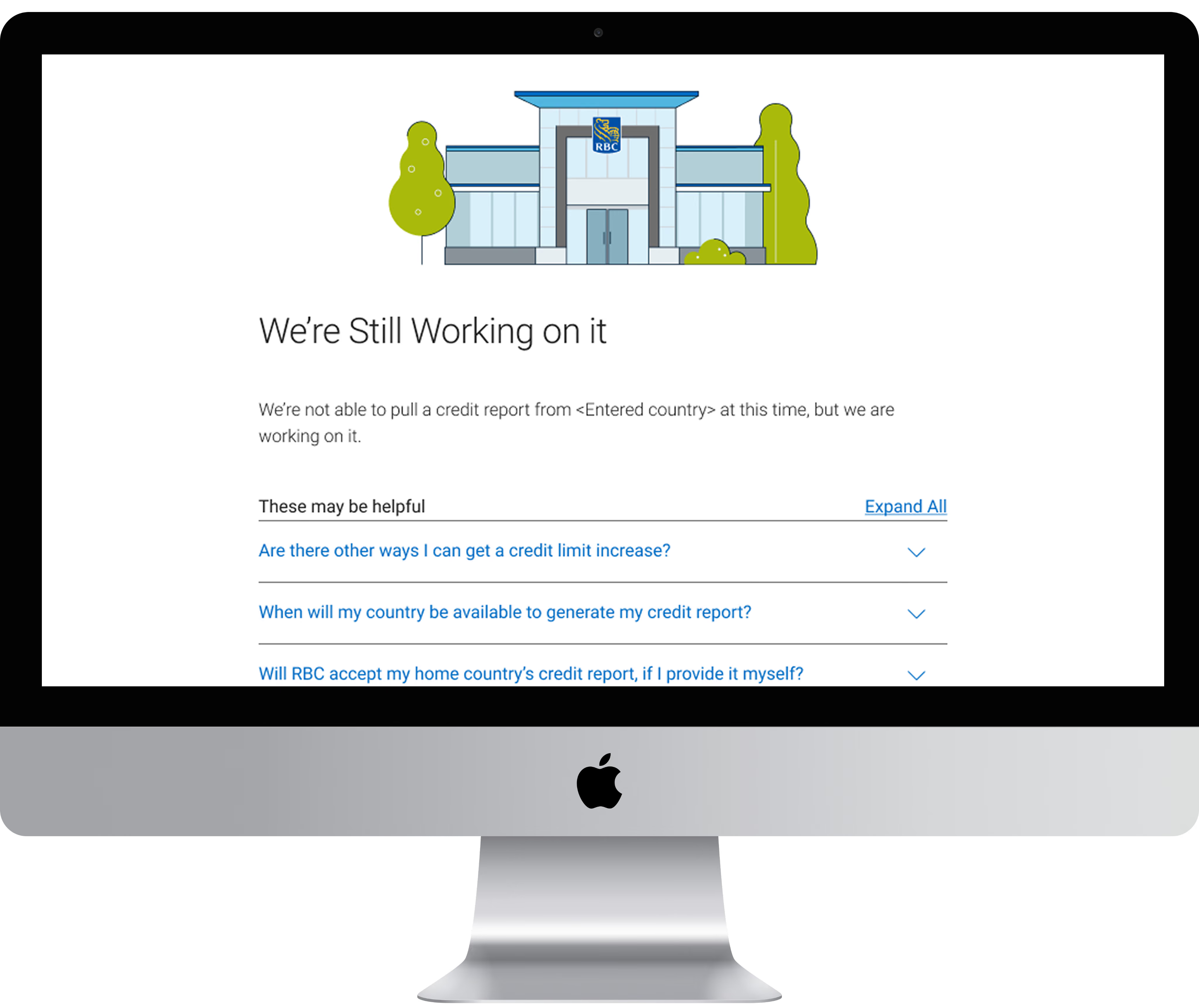
We're still working on it
Most people choosing a country would land here at launch, so this screen mattered as much as the main path. It names the country they chose and says honestly that we can't help yet, but that we're working on it.
The questions did two jobs. For newcomers, they pointed to their next possible options, so a “no” didn't end their hope of getting ahead: another way to a higher limit, when their country might be added, and whether they could bring the report themselves. For the bank, they kept the conversation going so potential clients weren't lost at a dead end. RBC's goal is to earn as much of each client's share of wallet as possible, and that starts with not turning people away.
Business and product owned the answers, so every response would be accurate before launch.
“Are there other ways I can get a credit limit increase?” “When will my country be available to generate my credit report?” “Will RBC accept my home country's credit report, if I provide it myself?”
looking back
What I'd rewrite today
The flow was designed fast, with a third party's requirements shifting underneath it. Some of the shipped wording was more formal or hedged than it needed to be. Here's how I'd tighten it now: sentence case, shorter sentences and no hedging.
shipped
Use Your Home Country's Credit Report RBC allows Canadian newcomers to use their foreign credit report to apply for higher credit limits, credit cards and more.
today
Use your credit report from home Already have credit in another country? Share your credit report with RBC and you could get a higher credit limit.
Sentence case, and it speaks to the person instead of describing what RBC allows.
shipped
Any person who is new to Canada, may attempt to use their credit report from their home country to apply. All countries do maintain a credit report, however we may not have access to all countries right away.
today
If you're new to Canada, you can try using your credit report from home. Most countries keep credit reports, but we can't reach every country yet.
Removes the hedging (“may attempt”) and the comma splice, and doesn't promise that every country has one.
shipped
Below are the steps you are required to take to complete this process
today
5 steps to share your credit report
Says what the list is in six words, without “required” or “process”.
shipped
Provide the most recent number even if you don't have access to this number anymore.
today
Don't have this number anymore? Enter the last one you used.
Leads with the situation people are in, so they recognize themselves first.
shipped
We're Still Working on it We're not able to pull a credit report from <Entered country> at this time, but we are working on it.
today
We can't get credit reports from [country] yet We're working on adding more countries. In the meantime, here are other ways to build your credit.
States the fact in the heading, drops “pull”, and points straight to the next options.
shipped
Thanks for Sharing Your Credit Report You have successfully shared your credit bureau report from <country>. We will apply your report to your credit application and start building your credit profile in Canada.
today
Your credit report has been shared We'll use it for your credit card application. It's also the first step in building your credit in Canada.
Confirms the outcome in the heading and uses “credit report” consistently, without the leftover “bureau”.
where it landed
The explainer shipped. The newcomer flow paused.
The credit bureau consent screen and its credit explainer launched in account opening. The newcomer flow itself was paused because of a bank merger and other design priorities, so it never shipped. Legal had aligned on the flow and the points of consent, but final legal copy hadn't been provided yet. When it was paused, the plan was:
Test with advisors first
The business planned to roll out an advisor-facing version to see how well the steps worked, then use advisors' insights to add tips that make each step clearer.
Ask for less from home
Refine the requirements to rely less on home-country details, starting with the phone number many newcomers no longer have.
Add countries
Use the country choices people made on the entry screen to decide which countries to support after India, China and the Philippines.
PROTOTYPE
Click through the flow
Walk through the full flow in Figma, from the account opening consent to sharing a report, including the upload path and the screen for countries that aren't available yet.